Interior waterproofing addresses moisture that has already entered or is entering a basement from the inside. Unlike exterior approaches, which attempt to keep water away from the foundation entirely, interior methods manage water after it crosses the wall or slab, directing it to a controlled exit point. In Canadian homes where exterior excavation is cost-prohibitive or structurally impractical, interior systems are often the primary intervention.
Interior Drainage Channels
An interior perimeter drainage channel, sometimes called a French drain or weeping tile system, is installed beneath the basement floor along the base of the foundation walls. A trench roughly 300 to 500 mm wide is cut through the concrete slab at the perimeter. Perforated pipe or a purpose-built drainage track is set in the trench on a bed of clean washed stone, then covered with new concrete.
Water that seeps through the foundation wall runs down the interior face and enters the drainage channel at the floor level, rather than pooling on the floor. The channel directs water by gravity to a sump pit, where a sump pump ejects it away from the structure. Most systems include a filter fabric sleeve around the perforated pipe to prevent fine particles from clogging the aggregate over time.
Interior drainage systems do not stop water from entering the foundation. They intercept and redirect it. Where active leaks are present, the underlying crack or joint gap should be assessed and addressed separately before or alongside installing a drainage system.
Sump Pump Systems
A sump pump is installed in a pit excavated into the basement floor, typically at the lowest point or at the terminus of an interior drainage channel. The pump activates when water in the pit reaches a float-triggered threshold and discharges through a pipe that exits above grade, directing water well away from the foundation.
Submersible vs. Pedestal Pumps
Submersible pumps sit inside the pit with the motor sealed against water. They operate more quietly and are generally preferred for finished basement applications. Pedestal pumps mount the motor above the pit on a vertical shaft, making the motor more accessible for servicing but more visible and audible during operation.
Battery Backup
Power outages in Canada often coincide with the storms that generate the heaviest rainfall. A battery backup sump pump activates when the primary pump fails or loses power. Some systems use a municipal water pressure-powered backup pump that operates without electricity at all. The Canada Mortgage and Housing Corporation references backup pump systems in its guidance on reducing basement flooding risk.
Crystalline Waterproofing Compounds
Crystalline waterproofing is applied as a slurry or dry-shake coating to the interior face of concrete walls and slabs. The active chemicals — typically Portland cement, fine sand, and proprietary crystalline components — react with moisture and calcium hydroxide in the concrete to form insoluble crystals within the capillary structure of the material.
This process seals the microscopic voids and hairline cracks that allow water to wick through poured concrete and concrete block walls. Unlike membranes that rely on adhesion to a surface, crystalline treatments become part of the concrete matrix and are not susceptible to delamination. They are commonly used in new construction but can be applied retroactively on cleaned, prepared concrete surfaces.
Limitations
Crystalline products are effective against moisture migration through sound concrete. They are not designed to bridge large active cracks where structural movement is ongoing, and they do not address drainage issues at the footing level. For walls with visible crack patterns wider than approximately 0.5 mm, crack injection is typically required in addition to a crystalline coating.
Closed-Cell Spray Foam Insulation
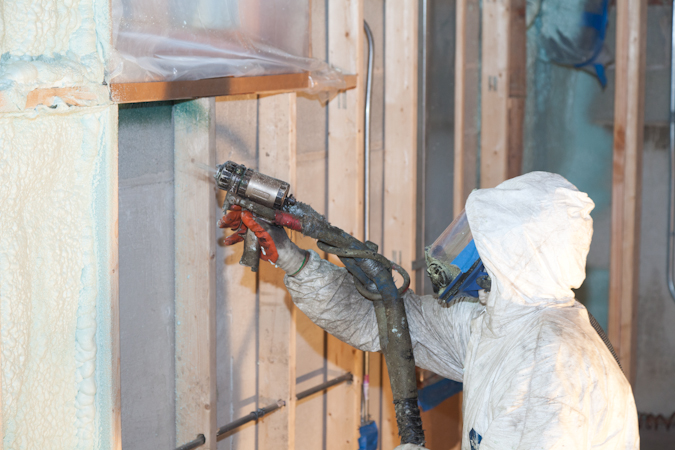
Closed-cell polyurethane spray foam, applied directly to the interior face of a concrete or concrete block foundation wall, serves as both an air barrier and a vapour retarder. At a thickness of approximately 50 mm, closed-cell foam achieves a vapour permeance low enough to meet the requirements of many provincial building codes for below-grade walls when installed as the primary vapour control layer.
The foam adheres directly to the masonry surface, eliminating the air gap between the wall and the insulation assembly that can otherwise allow warm interior air to contact the cold wall and deposit condensation. Because there is no cavity for moisture to collect in, mould growth behind the insulation is significantly reduced compared to batt insulation installed with a freestanding vapour barrier.
Application Notes
Spray foam must be applied by a licensed contractor using calibrated equipment. The two-component mixture requires precise temperature and ratio control during application. Once cured, the foam must be covered with a thermal barrier such as drywall, as closed-cell foam is combustible and building codes in Canada require it to be protected from ignition sources in occupied spaces.
Crack Injection
Poured concrete foundations frequently develop vertical and diagonal shrinkage cracks as the concrete cures. These cracks are cosmetic in many cases but create direct pathways for water under hydrostatic pressure. Two materials are used for injection repair:
Polyurethane Foam Injection
A two-part polyurethane is injected into the crack under low pressure. When it contacts moisture in the crack, it expands to fill the void and cures to a flexible foam. This flexibility allows the repair to accommodate minor seasonal movement without reopening. Polyurethane injection is generally used for actively leaking cracks where water needs to be stopped immediately.
Epoxy Injection
Epoxy injection is used for structural crack repair in dry or barely moist conditions. The epoxy bonds both faces of the crack and cures to a material harder than the surrounding concrete, restoring load transfer across the repaired section. Epoxy is not flexible and is not suitable for cracks subject to ongoing movement.
When Interior Alone Is Not Sufficient
Interior waterproofing systems manage the symptoms of water intrusion effectively in many situations. However, they do not address the deterioration of the exterior waterproofing membrane, failed exterior drainage, or saturated backfill. In cases where hydrostatic pressure is severe enough to cause structural damage — bowing or cracking block walls, for example — the exterior conditions driving that pressure typically need to be resolved directly.
A qualified contractor should assess whether an interior drainage system is appropriate or whether exterior intervention is warranted. In some jurisdictions, permits are required even for interior drainage work, particularly if it involves breaking the existing slab.